
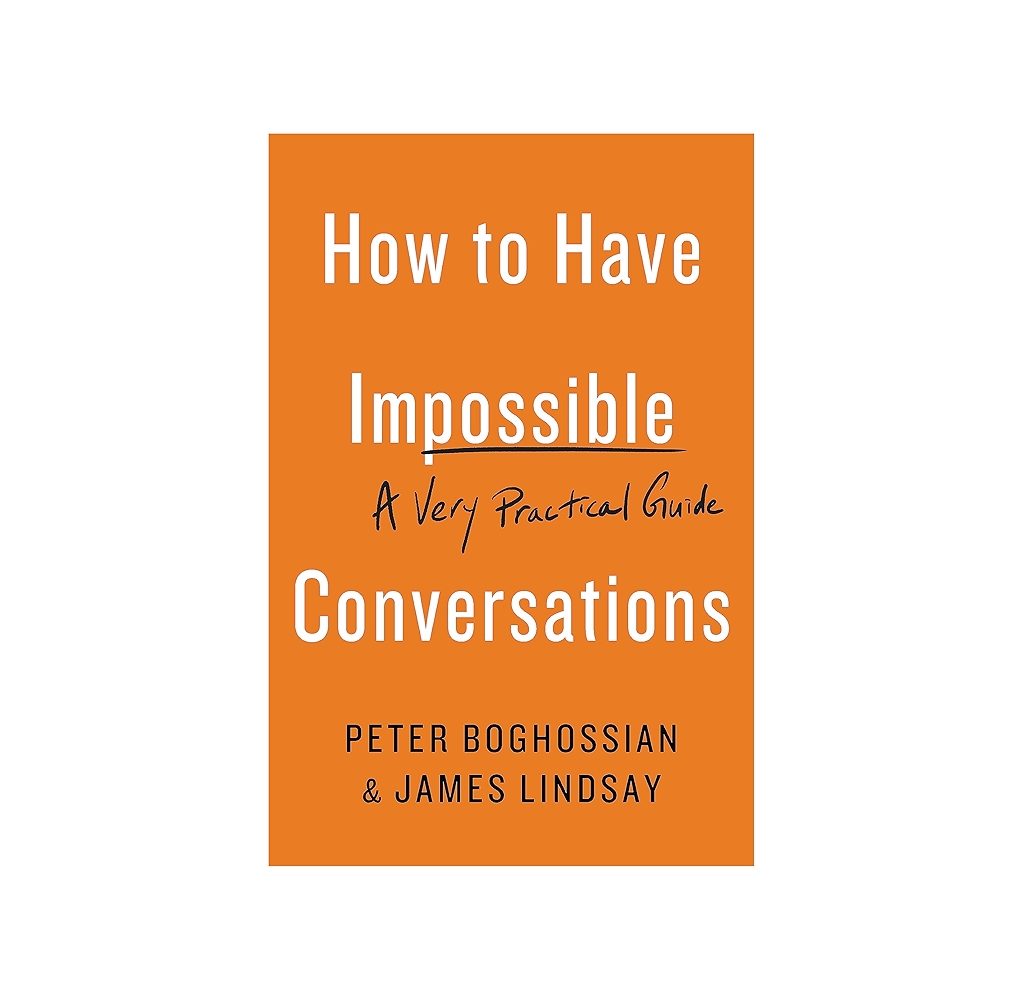
In an era of hyper-polarization and digital echo chambers, why have we forgotten how to talk to one another? We live in a cultural moment where disagreement is often treated as a moral failing rather than a fundamental component of a free society. In How to Have Impossible Conversations, Peter Boghossian and James Lindsay offer more than just a communication guide; they provide a tactical manual for intellectual de-escalation. As someone who believes that our dignity is tied to our ability to exercise nuanced judgment, I found this book to be a necessary corrective to the “transactional chill” of modern public discourse.
The authors start with a sobering reality check: most of us are bad at disagreeing because we prioritize being “right” over being effective. We enter conversations like trial lawyers seeking a conviction rather than explorers seeking the truth. Boghossian and Lindsay introduce the concept of “Street Epistemology”—a method not of telling people what to think, but helping them examine how they know what they claim to know. It is a shift from the “what” to the “how,” and in that shift, the barricades of ideology begin to crumble.
One of the most potent takeaways is the “Rapoport’s Rules,” a set of protocols designed to foster productive disagreement. The first step? Re-express your opponent’s position so clearly, vividly, and fairly that they say, “Thanks, I wish I’d thought of putting it that way.” This isn’t just a politeness strategy; it’s a declaration of narrative reclamation. By truly understanding the “other side,” you earn the moral right to critique it. In our current climate of “snake oil” rhetoric and strawman arguments, this level of intellectual honesty is revolutionary.
The book also dives into the “instability of belief,” teaching us how to identify the foundations of a person’s conviction. Are they clinging to a fact, or are they clinging to an identity? Most “impossible” conversations fail because we throw data at people who are defending their sense of belonging. Boghossian and Lindsay show us how to navigate these emotional minefields with techniques like “the scale of confidence,” which forces us to quantify our certainty. It’s a tool for intellectual self-defense that prevents us from falling into the trap of dogmatism.
Perhaps the most challenging lesson is the art of the “graceful exit.” Not every conversation can be “won,” and not every bridge can be built in a single sitting. The authors remind us that the goal is often just to “leave a golden bridge” for the other person to cross later. This requires a level of patience and long-term thinking that is rare in the age of instant gratification and 280-character takedowns. It is about planting seeds of doubt rather than trying to burn down the entire forest of a person’s worldview.
This isn’t a “kumbaya” manifesto for radical centrism; it’s a rigorous, often uncomfortable exercise in humanizing the “enemy.” It demands that we stop trading our curiosity for magic beans of tribal certainty and start asking the hard questions—first of ourselves, and then of others. In a world where machines are increasingly used to simulate human connection, Boghossian and Lindsay argue that the most transformative technology we have is still a well-placed, honest question.
What do you think? Have we reached a point where some conversations are truly impossible, or have we just lost the tools to have them? Let’s stop shouting across the chasm and start building the scaffolding for a real dialogue. The future of our social fabric might just depend on it.