

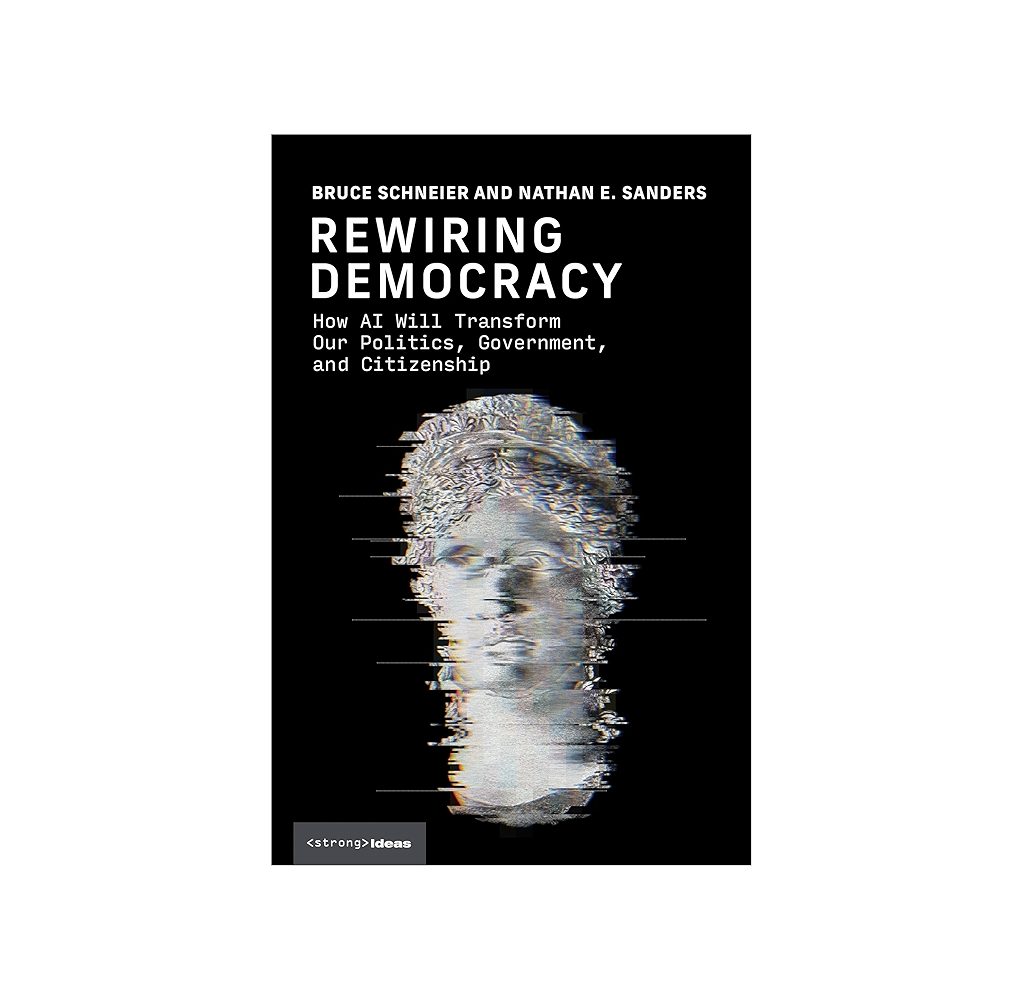
Have you ever wondered if the very digital tools we hoped would liberate our voices are actually the ones dismantling our capacity to govern ourselves?
In Rewiring Democracy, Bruce Schneier—a veteran voice in the world of security and cryptography—steps out of the server room and into the town square. He argues that our current democratic “operating system” is running on obsolete code, written for a world of quill pens and physical assembly. Today, that system is being overwhelmed by the high-speed, high-volume data flows of the internet, leaving our institutions vulnerable to “hacks” that range from algorithmic polarization to the systematic erosion of public trust.
Schneier’s central thesis is that we shouldn’t just be trying to “fix” the internet to save democracy; we need to redesign democracy to thrive in a digital age. He brilliantly dissects how the attention economy has commodified our political discourse, turning nuanced debate into a series of outrage-fueled clicks. It’s a sobering look at how the speed of modern technology outpaces the deliberate, often slow-moving nature of democratic deliberation, creating a friction that bad actors are all too happy to exploit.
The book doesn’t just admire the problem, though. Schneier dives into “public interest technology,” proposing that we build new digital architectures designed specifically for civic health rather than corporate profit. He explores fascinating concepts like “deliberative polling” and “liquid democracy,” where technology is used to scale up meaningful conversation rather than just scaling up noise. It’s an optimistic shift from his usual warnings, suggesting that if we can hack a system for harm, we can also engineer it for collective good.
What I found most compelling—and perhaps most challenging—is his insistence that there is no “neutral” technology. Every platform carries the values of its creators. By allowing private corporations to build the “plumbing” of our political world, we’ve effectively outsourced our democracy to entities whose bottom line doesn’t account for the common good. Schneier argues for a radical reinvestment in public digital infrastructure, treated with the same necessity as our roads or water systems.
Ultimately, Rewiring Democracy is a call to action for both geeks and governors. It’s a dense but readable roadmap for anyone tired of the “doom-scrolling” era of politics. Schneier reminds us that while the challenges are technical, the solutions are deeply human, requiring a renewed commitment to institutional design and civic participation. It’s not just about better firewalls; it’s about a better social contract.
As we look toward a future where AI and deeper automation will only further accelerate these cycles, we have to ask: Are we going to keep trying to patch a failing system, or are we brave enough to hit the reset button and build a democracy that actually works at the speed of light?