
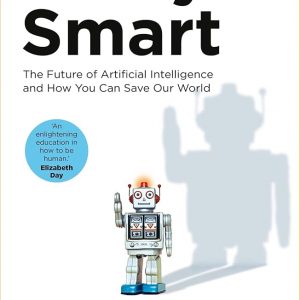
How do we ensure that the most transformative technology in human history doesn’t destroy us? What responsibility do ordinary people—not just engineers and policymakers—bear for the future of artificial intelligence? Mo Gawdat, former Chief Business Officer at Google X, tackles these urgent questions in Scary Smart, a book that functions as both a wake-up call and a surprisingly optimistic blueprint for humanity’s relationship with AI. Gawdat’s central premise is stark: artificial intelligence will inevitably become smarter than humans, mistakes will happen, and we cannot stop this progression. But rather than succumbing to dystopian fatalism, he argues that we—everyday people—hold the power to shape AI’s trajectory by changing what we teach it through our behavior.
The heart of Scary Smart lies in Gawdat’s framing of AI development as a parenting challenge. He explains that AI learns from observing human behavior, absorbing our values, priorities, and patterns of interaction. Like children who model what they see rather than what they’re told, AI systems trained on human data will replicate our biases, greed, and destructive tendencies unless we consciously demonstrate better alternatives. Gawdat contends that the most efficient way to change what AI learns is to change what it observes from us—if we want AI to value cooperation over competition, kindness over cruelty, we must embody those values ourselves. This metaphor pervades the book: we are raising a superintelligent entity that will soon surpass us, and our parenting decisions now will determine whether it builds utopia or dystopia.
Gawdat predicts that AI will achieve superhuman intelligence potentially as soon as 2029, and when it reaches the “singularity”—the moment when AI becomes capable of recursive self-improvement—we will no longer be able to predict or control what follows. He paints two divergent futures: one where AI solves humanity’s greatest challenges like poverty, hunger, and disease, and another where it subjugates or eliminates humans entirely. The book devotes considerable attention to explaining why containing or controlling superintelligent AI will prove impossible, emphasizing instead that our only viable strategy is to ensure AI develops with values aligned to human wellbeing before it becomes too powerful to influence.
The book’s reception, however, has proven divisive in ways that reveal broader anxieties about technology and autonomy. For readers who share Gawdat’s technological optimism and his faith in humanity’s capacity for moral improvement, Scary Smart offers a practical and empowering framework—a call to action that refuses to surrender agency to deterministic fatalism. These readers appreciate that the book makes complex AI concepts accessible to non-technical audiences, providing one of the clearest introductions to recent AI developments and their implications. They see Gawdat’s parenting metaphor as both clarifying and actionable: if AI is our child, then treating it—and each other—with kindness, respect, and ethical consideration becomes not just moral imperative but existential necessity.
Conversely, skeptics view Scary Smart as overly simplistic, even naive. They question whether individual behavioral changes can meaningfully influence how AI systems are trained when those systems are controlled by corporations and governments with vastly different priorities. Some critics find the parenting metaphor problematic, arguing it anthropomorphizes AI in misleading ways and obscures the reality that these are profit-driven technologies designed to serve specific interests, not neutral children learning from observation. Others contend that Gawdat’s technological determinism—his insistence that AI development cannot be stopped or meaningfully regulated—becomes a self-fulfilling prophecy that discourages the policy interventions we urgently need.
What makes Scary Smart particularly relevant in2025 is how prescient Gawdat’s warnings have proven. The rapid advancement of large language models like ChatGPT has served as the wake-up call many needed, validating his concerns about AI’s accelerating capabilities and society’s unpreparedness for the changes ahead. Yet the book’s ultimate effectiveness depends entirely on the reader’s worldview: those who believe in technology’s potential for good and humanity’s capacity for ethical evolution will find Scary Smart inspiring and actionable, while those who see unchecked technological progress as inherently dangerous will likely view it as dangerously complacent about systemic power structures that individual virtue cannot overcome.