
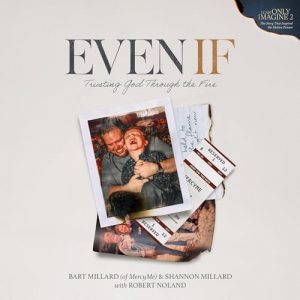
Have you ever looked at your life and thought, “This wasn’t part of the deal,” while watching everyone else’s digital highlight reel play out in real-time? In Even If, Bart Millard—the voice behind the mega-hit “I Can Only Imagine”—pulls back the curtain on the exhausting reality of living when life refuses to be “fair.” For those of us navigating 2026, where the pressure to project a perfectly curated, high-vibe life is at an all-time high, Millard’s message is a refreshing, albeit gritty, reality check. It’s a book for anyone who has prayed for a miracle and received a “not yet” or a “no” instead.
The foundational heartbeat of the book is the story of Shadrach, Meshach, and Abednego from the book of Daniel. Standing before a fiery furnace, they famously declared that their God was capable of saving them, “but even if He does not,” they still wouldn’t bow to an idol. Millard takes this “Even If” theology and applies it to the deep, jagged cracks in his own life—specifically his son’s lifelong battle with Type 1 Diabetes and the lingering shadows of his own abusive childhood. It’s an exploration of Resilient Faith, the kind that doesn’t crumble when the “blessing” doesn’t arrive on schedule.
One of the most profound takeaways for anyone struggling with a “it’s not fair” season is Millard’s rejection of toxic positivity. We live in a world that often demands we “find the silver lining” or “just have more faith,” but Millard argues that true spiritual and emotional growth happens when we stop pretending. He writes candidly about the fatigue of being the “I Can Only Imagine” guy while privately grieving his son’s health. In 2026, where authenticity is the only currency that still holds value, Millard shows us that admitting we are broken isn’t a failure of character; it’s the prerequisite for genuine healing.
Millard also introduces the concept of Productive Realism—the ability to hold deep sorrow and profound joy in the same hand. This is the “Genius of the AND” applied to the human soul. You can be frustrated by your circumstances andgrateful for your life. You can be mourning a loss and enjoying a sunset. By giving us permission to experience the full spectrum of human emotion simultaneously, Millard releases us from the binary trap of thinking we have to be “all okay” or “all destroyed.”
Furthermore, the book tackles the Inherited Narrative—the stories we tell ourselves about how life “should” have gone. Most of our pain comes from the gap between our expectations and our reality. Millard shares how he had to deconstruct the version of his life he thought he was entitled to in order to find the beauty in the life he actually had. This is a vital lesson for 2026: we cannot experience the peace of the present if we are constantly litigating the “unfairness” of the past. It’s about firing small “bullets” of acceptance every day until we have the strength to let go of the “cannonballs” of resentment.
Ultimately, Even If is a masterclass in Steadfastness. It reminds us that while the tools of our modern age might offer temporary distractions or efficiency, they cannot solve the ancient problem of human suffering. Millard’s journey encourages us to build our lives on a foundation that isn’t tied to our circumstances, our health, or our bank accounts. It is a call to find a “home” in a purpose that remains unshaken even when the world feels like it’s falling apart.
What is the one “Even If” scenario currently keeping you up at night, and how would accepting that outcome today change the way you move through your world tomorrow?